Print marketing is not dead. It has simply changed.
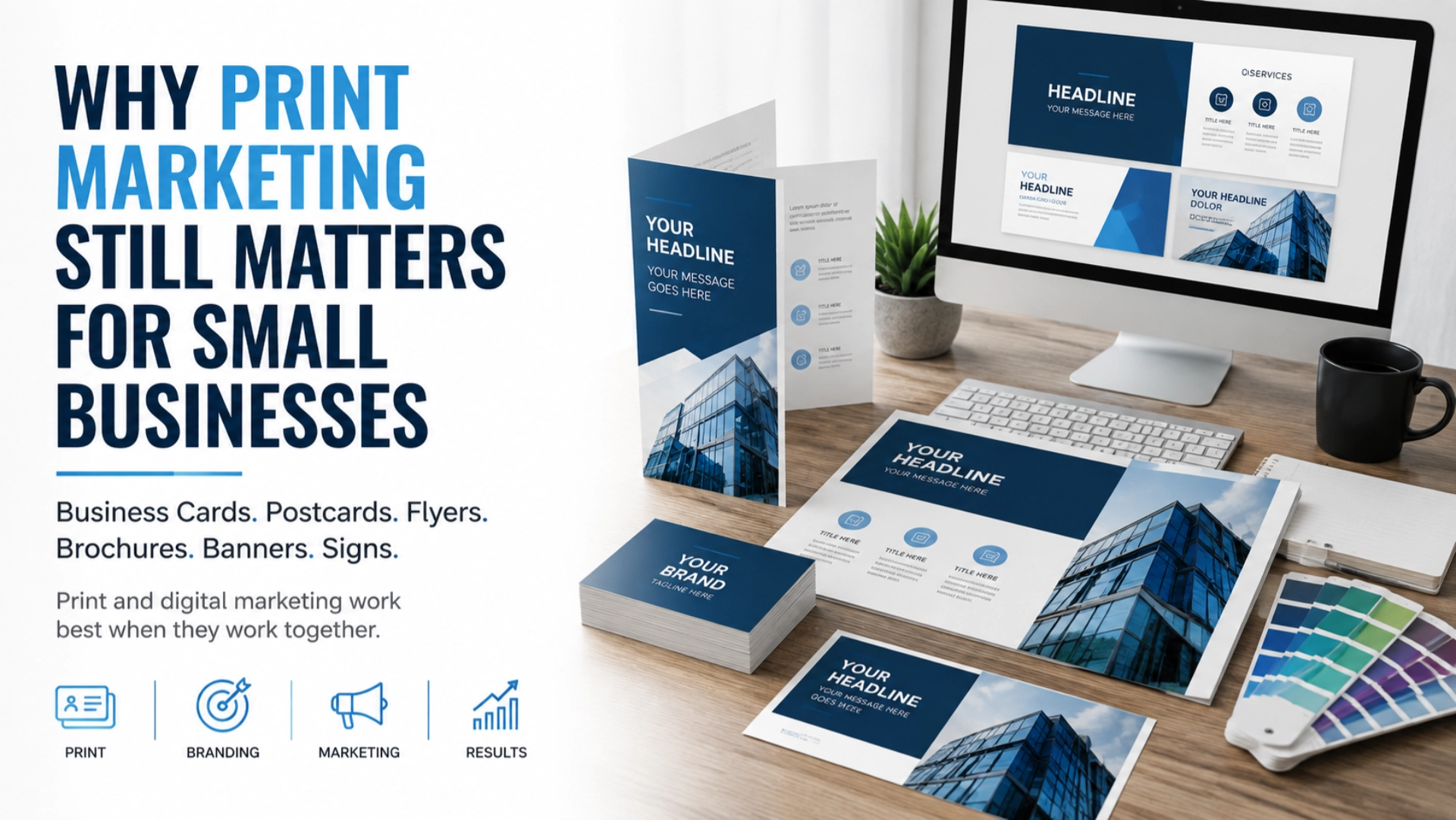
For small businesses, printed materials still play an important role in building trust, promoting services, supporting local visibility, and giving customers something tangible to remember. Business cards, postcards, flyers, brochures, banners, signs, labels, and event displays can all help a business look more professional and stay in front of the right audience.
The problem is that print marketing does not work well when it is treated as an afterthought. A random flyer, outdated brochure, or poorly designed business card may not do much to help your business. But when print materials are designed with a clear message, consistent branding, and a specific purpose, they can become a valuable part of your overall marketing strategy.
Print works best when it supports everything else your business is doing. Your website, social media graphics, online ads, branding, SEO content, and printed materials should all feel connected. When they work together, your business looks more established, more trustworthy, and easier to remember.
For small businesses that serve a local market, print marketing can be especially useful. It can help promote events, announce services, support direct mail campaigns, improve in-person sales conversations, and create visibility in places where digital ads may never appear.
The key is not simply printing more materials. The key is creating better materials that look professional, communicate clearly, and support your business goals.
Print Marketing Creates a Physical Connection
Digital marketing is important, but it is also easy to scroll past, ignore, or forget. Printed materials create a different kind of connection because they are physical. A customer can hold a business card, keep a brochure, save a postcard, walk past a banner, or place a flyer on a desk for later.
That physical presence can make your business feel more real and memorable.
For small businesses, this can be especially valuable. A well-designed printed piece can support a sales conversation, introduce your services, promote a special offer, or remind someone to visit your website after they have already interacted with your brand.
Print also works well in local marketing because it can reach people in specific places. A flyer can be handed out at an event. A postcard can reach a neighborhood. A banner can catch attention at a storefront, booth, or community event. A brochure can help explain services when a customer needs more information than a quick social media post can provide.
The goal is not to choose print instead of digital. The goal is to use print as another way to build recognition, trust, and response. When your printed materials are professional, clear, and consistent with the rest of your marketing, they help reinforce your message in a way that digital marketing alone may not.
Business Cards, Flyers, and Brochures Still Have a Place
Even in a digital-first world, traditional print materials still serve an important purpose. Business cards, flyers, and brochures give small businesses simple, practical tools they can use in everyday conversations, local events, meetings, networking, sales presentations, and customer follow-ups.
A business card is more than just contact information. When it is designed well, it gives someone a quick impression of your brand. It should feel professional, be easy to read, and make it simple for someone to contact you later.
Flyers are useful when you need to promote something specific. That could be a sale, event, new service, grand opening, seasonal offer, or local campaign. A strong flyer should grab attention quickly, explain the message clearly, and include a clear next step.
Brochures are helpful when your business needs to explain more. They can introduce your services, answer common questions, highlight benefits, show examples, and give potential customers something they can review after the conversation ends.
The key is quality and purpose. Print materials should not feel cluttered, outdated, or disconnected from the rest of your brand. They should support your larger marketing message and help move people closer to taking action.
When business cards, flyers, and brochures are designed with strategy, they can still be valuable tools for small businesses that want to look professional, stay memorable, and communicate clearly.
Postcards and Direct Mail Can Support Local Marketing
Postcards and direct mail can still be useful for small businesses, especially when the goal is to reach a specific local audience. Unlike online ads that disappear quickly, a postcard gives people something physical they can hold, save, or place somewhere visible.
This can be helpful for service businesses, local promotions, seasonal offers, neighborhood campaigns, grand openings, real estate marketing, nonprofit outreach, and appointment-based businesses. A well-designed postcard can introduce your business, highlight an offer, announce a service, or remind past customers to take the next step.
The most effective postcards are simple and focused. They do not try to say everything at once. They use a strong headline, clear visuals, a short message, and an obvious call to action. The design should make it easy for someone to understand who you are, what you offer, and what they should do next.
Direct mail also works better when it connects with your digital marketing. A postcard can send people to a landing page, service page, online form, QR code, phone number, or special offer. This helps bridge the gap between offline attention and online action.
For small businesses that serve a defined area, postcards and direct mail can be a practical way to stay visible in the community and support a broader marketing campaign.
Large Format Printing Helps Businesses Get Noticed
Large format printing can help small businesses stand out in places where customers are already looking. Banners, signs, posters, window graphics, car magnets, event tents, trade show displays, and SEG displays can all create visibility in a physical space.
This type of print marketing is especially useful for storefronts, events, community promotions, grand openings, sales, markets, trade shows, and service businesses that want their brand to be seen around town.
The advantage of large format printing is visibility. A business card or brochure may support a one-on-one conversation, but a banner or sign can attract attention from a distance. It can help people notice your location, remember your name, understand what you offer, or recognize your business at an event.
Design matters because large format pieces need to communicate quickly. People may only have a few seconds to read the message. A strong design should use clear branding, readable type, high-quality graphics, and a simple message that can be understood at a glance.
When large format printing is designed well, it can make a small business look more established, professional, and visible. It can also support your website, social media, and other marketing by keeping your brand in front of people offline.
Print Works Best When It Matches Your Brand
Print marketing is most effective when it feels connected to the rest of your business. Your printed materials should look and sound like they belong with your website, logo, social media graphics, email marketing, signage, and other customer-facing materials.
That kind of consistency helps people recognize your business faster. When your colors, fonts, imagery, message, and layout style are used consistently, your brand becomes easier to remember. Over time, that familiarity can help build trust.
The opposite is also true. If your business card looks one way, your website looks another way, and your flyers use a completely different style, your marketing can feel disconnected. Even if each piece looks fine on its own, the overall impression may feel less professional.
A strong print design should support your brand identity while still fitting the purpose of the piece. A postcard may need a bold offer. A brochure may need more structure and detail. A banner may need large, simple text that can be read quickly. A label or sticker may need to look clean and recognizable at a smaller size.
The goal is not for every piece to look exactly the same. The goal is for every piece to feel like it comes from the same business.
When your print materials are designed with brand consistency in mind, they do more than share information. They strengthen recognition, reinforce your message, and help your business look more polished across every customer touchpoint.
How Print and Digital Marketing Work Together
Print and digital marketing should not compete with each other. For many small businesses, they work best when they support the same message across different places.
A postcard can send people to a website. A flyer can promote a QR code. A business card can include a service page or portfolio link. A brochure can reinforce the same message a customer saw online. A banner or sign can help people recognize your business after seeing your social media posts, Google Business Profile, or online ads.
This kind of connection makes your marketing feel more complete. Instead of having separate pieces that do not relate to each other, your print and digital materials can guide people through the same brand experience.
For example, a local service business might use postcards to introduce a seasonal offer, send visitors to a landing page, and follow up with social media graphics using the same message and visual style. A business attending an event might use a banner, table display, business cards, flyers, and website updates that all promote the same service or offer.
Print can help create awareness offline, while digital marketing can make it easier for people to learn more, contact you, request a quote, or place an order. When both sides are designed to work together, your business has more opportunities to stay visible and turn interest into action.
The strongest marketing does not rely on one channel. It uses the right combination of print, web, social media, SEO, and branding to create a consistent message wherever customers find you.
Work With David Arthur Design for Print Marketing Support
Print marketing can still be a powerful tool for small businesses, but it works best when the design, message, and strategy are handled correctly. A printed piece should not simply look good on its own. It should support your brand, connect with your audience, and guide people toward the next step.
David Arthur Design helps small businesses create professional print materials that work with the rest of their marketing. This may include business cards, postcards, flyers, brochures, pamphlets, stickers, labels, banners, signs, event displays, car magnets, and other custom print pieces.
With more than 30 years of graphic design and print experience, David Arthur Design understands how to prepare artwork that looks polished, communicates clearly, and is built properly for production. From layout and typography to color, resolution, file setup, and print-ready formatting, the details matter.
The goal is to create print marketing that feels professional, consistent, and useful. Whether you need a single printed piece or a larger print campaign that connects with your website, branding, and digital marketing, David Arthur Design can help bring everything together.
If your business is ready to improve its printed materials, promote a service, support a local campaign, or create a more consistent brand experience, professional print marketing design can help you make a stronger impression.
Frequently Asked Questions About Print Marketing
Yes. Print marketing can still be effective for small businesses when it is designed with a clear message, strong branding, and a specific purpose. Business cards, postcards, flyers, brochures, banners, signs, and other printed materials can help build trust, support local visibility, and give customers something physical to remember.
The best print materials depend on the business and the goal. Common options include business cards, postcards, flyers, brochures, pamphlets, stickers, labels, banners, signs, event tents, car magnets, and displays. A local service business may benefit from postcards and flyers, while a storefront or event-based business may need banners, signs, or large format displays.
Print design should match your brand so your business looks consistent and professional across every customer touchpoint. When your business cards, brochures, postcards, signs, website, and social media graphics all share a similar style, customers are more likely to recognize and remember your business.
Print marketing can support digital marketing by sending people to your website, landing page, online form, social media profile, or special offer. QR codes, website links, phone numbers, and consistent campaign messaging can help connect offline attention with online action.
An effective printed marketing piece should have a clear purpose, strong headline, readable layout, professional design, consistent branding, and an obvious next step. It should quickly communicate who you are, what you offer, and what the customer should do next.
Direct mail can still be useful for local businesses that want to reach a specific neighborhood, service area, or customer group. Postcards and mailers can be especially helpful for promoting seasonal offers, grand openings, local services, events, or reminders to past customers.
Yes. David Arthur Design can help with the design and setup of print marketing materials, including business cards, postcards, flyers, brochures, banners, signs, labels, stickers, and other printed pieces. The goal is to create professional, print-ready materials that match your brand and support your marketing goals.