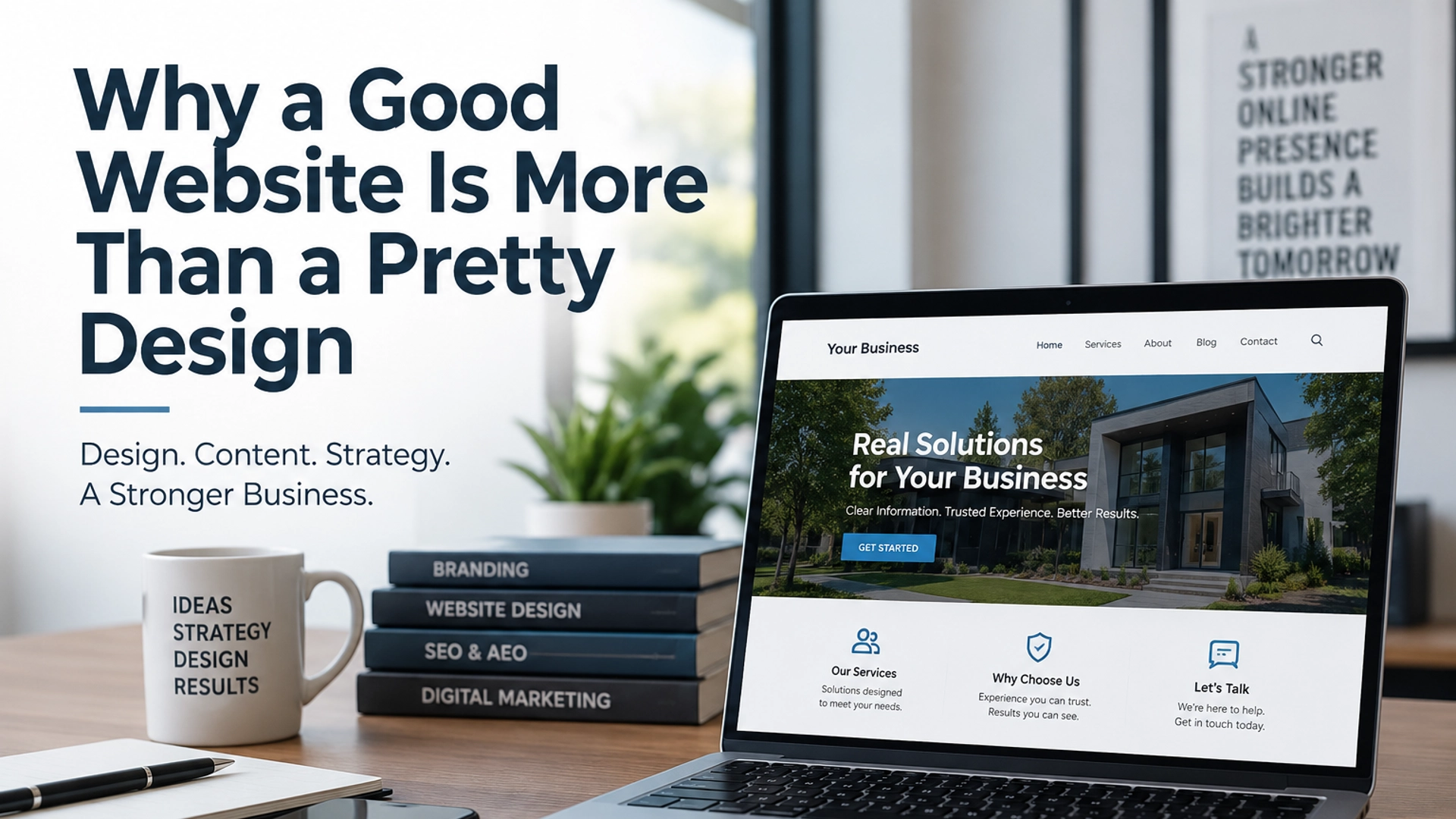
A good website should look professional, but appearance alone is not enough. For a small business, a website is not just a place to display a logo, list a few services, and add a contact form. It is often the first serious interaction a potential customer has with your business. Before they call, request a quote, schedule an appointment, or visit your location, they are using your website to decide whether your business feels credible, clear, helpful, and worth their time.
That decision usually happens quickly.
When someone lands on your website, they are not simply judging whether the design looks nice. They are trying to answer practical questions. Do you offer what they need? Do you serve their area? Do you understand their problem? Can they trust you? Is your business professional? Is it easy to contact you? Are you the right choice compared to the other companies they are reviewing?
A strong small business website should help answer those questions. It should combine design, content, structure, branding, search visibility, and clear calls to action into one organized experience. The layout should guide visitors through the page. The copy should explain your services in plain language. The visuals should support your brand. The navigation should feel simple. The page structure should help search engines understand what your business does. The overall experience should make it easier for a visitor to take the next step.
This is why effective website design is about more than making a site look attractive. A pretty website that does not explain the business clearly may fail to generate leads. A search-optimized website that looks outdated or confusing may fail to build trust. A site with strong visuals but weak messaging may leave visitors unsure about what to do next.
The best small business websites are built with purpose. They are designed to support the customer’s decision-making process, strengthen the brand, improve visibility, and turn interest into action. When design, content, SEO, and strategy work together, a website becomes more than an online brochure. It becomes a practical marketing tool that helps your business get found, understood, and chosen.
A Website Should Be Built Around the Customer’s Decision Process
Most people do not visit a small business website just to admire the design. They arrive with a need, a question, a problem, or a decision to make. They may be comparing several companies, checking whether your services match what they need, looking for pricing clues, reviewing your experience, or simply trying to decide whether your business feels trustworthy enough to contact.
That is why a website should be built around the customer’s decision process.
A visitor usually moves through a series of questions, even if they do not consciously think about them in order. They want to know what you do, whether you can help them, whether you understand their situation, whether you look credible, and what they should do next. If your website does not answer those questions clearly, the visitor may leave and continue searching.
Good website design helps guide that decision. The homepage should quickly explain the business and create confidence. Service pages should describe what you offer in enough detail to be useful. Calls to action should be placed where they make sense, not hidden at the bottom of the page. Navigation should make it easy for visitors to move from general information to more specific answers.
This is especially important for small businesses because customers often have limited time and many choices. A confusing website creates friction. If someone has to search too hard for your services, contact information, service area, examples of work, or next steps, they may assume working with the business will be just as difficult.
A strong website removes that friction. It gives visitors a clear path. It helps them understand the value of the business before asking them to take action. It answers common concerns before they become objections. It makes the next step feel simple and natural.
When a website is planned around the customer’s decision process, every part of the page has a job. The headline introduces the value. The content explains the service. The visuals reinforce the brand. The structure supports scanning. The call to action invites the next step. Together, those elements help turn a casual visitor into a more confident lead.
Design Is Not Decoration — It Is Communication
Website design is sometimes treated as decoration, as if the visual design is something added after the “real” content is finished. But good design is not just about making a page look attractive. Design is communication. It affects what people notice first, how they move through the page, what they understand, and how they feel about the business.
Every design choice sends a message. The spacing, colors, fonts, images, icons, buttons, page sections, and layout all influence the visitor’s experience. A clean, organized design can make a business feel professional and reliable. A cluttered or outdated design can make the same business feel less trustworthy, even if the actual service is excellent.
Good design also helps people absorb information. Most website visitors scan before they read. They look at headlines, images, short sections, buttons, and visual cues to decide whether the page is worth their time. If the page is difficult to scan, the message can get lost. If everything looks equally important, nothing stands out.
This is where visual hierarchy matters. The most important message should be easy to see. The visitor should understand the main service or offer quickly. Supporting details should be arranged in a way that feels natural. Calls to action should be visible without feeling pushy. The page should guide the eye instead of forcing the visitor to figure everything out on their own.
Design also plays a major role in trust. A potential customer may not be able to explain why a website feels professional or unprofessional, but they will often sense it immediately. Consistent branding, quality images, readable typography, balanced spacing, and polished layouts all help create confidence. These details tell visitors that the business pays attention to presentation and quality.
For small businesses, that trust can make a real difference. Your website may be competing against larger companies, national brands, or several local competitors. Strong design helps level the playing field by making your business look credible, established, and serious about the customer experience.
A pretty website may get attention, but a well-designed website does more than that. It organizes information, supports the brand, improves readability, builds trust, and helps visitors move toward a decision. That is why design should never be treated as decoration. It should be treated as one of the most important parts of the message.
Your Content Needs to Explain, Reassure, and Convert
The words on a website matter just as much as the design. A professional layout may create a strong first impression, but the content is what helps visitors understand the business, feel confident, and decide whether to take the next step.
Many small business websites are too vague. They may list services, but they do not explain them clearly. They may use short phrases like “quality service,” “trusted solutions,” or “we care about our customers,” but they do not give visitors enough useful information to make a decision. The result is a website that looks complete on the surface but does not actually answer the questions potential customers have.
Good website content should explain what you do in plain language. It should describe your services, identify who you help, clarify your process, and show why your business is a good choice. Visitors should not have to guess whether you offer what they need. The content should guide them from basic understanding to greater confidence.
Content also needs to reassure. Before someone contacts a small business, they may have doubts. They may wonder whether the business is experienced, professional, responsive, affordable, or capable of handling their specific need. A strong website can address those concerns through clear service descriptions, examples of work, testimonials, frequently asked questions, credentials, case studies, guarantees, or simple explanations of what happens next.
This is especially important because not every visitor is ready to call immediately. Some people are still researching. Some are comparing options. Some need to understand the service better before they feel comfortable reaching out. Helpful content gives those visitors a reason to stay longer, learn more, and remember the business.
Calls to action are also part of the content strategy. A website should make it clear what the visitor should do next, but it should not rely on one button at the bottom of the page. The call to action should appear naturally throughout the experience, especially after important sections where the visitor has learned enough to move forward.
Effective website content does three important things. It explains the business clearly, reassures the visitor that they are in the right place, and encourages them to take action. When content is written with that purpose, the website becomes more than a collection of pages. It becomes a guided conversation between the business and the potential customer.
SEO and AEO Should Be Built Into the Page Structure
A website should be designed for people first, but it also needs to be structured in a way that search engines and answer engines can understand. This is where SEO and AEO become part of the website planning process, not something that gets added later as an afterthought.
SEO, or search engine optimization, helps search engines understand what your pages are about. For a small business, this includes clear page titles, useful headings, service-focused content, internal links, image descriptions, local relevance, and pages that are organized around the actual services people are searching for.
AEO, or answer engine optimization, is closely related, but it focuses more on how content is understood by AI-powered search tools, voice search, featured snippets, and answer-style results. As search continues to change, websites need to answer questions clearly, define services, include helpful explanations, and use a structure that makes important information easy to identify.
This does not mean stuffing pages with keywords. In fact, keyword-heavy content that sounds unnatural can make a website feel less trustworthy. A better approach is to create pages that are genuinely useful. Each page should have a clear topic, a logical heading structure, helpful explanations, and content that answers the kinds of questions customers are likely to ask.
For example, a service page should not simply say that a business offers a service. It should explain what the service includes, who it is for, when someone may need it, what makes the business different, and what the visitor should do next. Supporting sections like FAQs, process explanations, service area details, and internal links can help both visitors and search systems better understand the page.
The technical structure also matters. Clean navigation, readable URLs, mobile-friendly layouts, fast-loading pages, properly named images, schema markup, and organized content all help create a stronger foundation. These details may not always be visible to the average visitor, but they can affect how well the website performs.
When SEO and AEO are considered during the design and content process, the website becomes more complete. It is not just a nice-looking page with words added to it. It is a structured marketing asset built to be found, understood, and used by both people and search systems.
Your Website Should Connect With the Rest of Your Marketing
A website should not feel separate from the rest of your marketing. It should be the central place where your brand, message, services, and customer experience come together.
For many small businesses, marketing grows in pieces over time. A logo may be created first, then business cards, then a flyer, then a website, then social media graphics, then a brochure, then a Google Business Profile, then a few ads or email campaigns. If those pieces are created at different times without a clear system, the business can end up with marketing that feels disconnected.
That disconnect can create confusion. A customer may see one style on social media, a different message on the website, and another look on a printed piece. Even when each item is professionally made, the overall brand may feel inconsistent. Consistency matters because people usually need repeated exposure before they remember a business or feel comfortable taking action.
Your website should help create that consistency. The colors, typography, imagery, tone of voice, service descriptions, and calls to action should reflect the same brand customers see everywhere else. When someone moves from a postcard to your website, or from a social media post to a landing page, the experience should feel connected.
This is also why website design should consider more than the website itself. A strong website can support print marketing, social media, email marketing, Google Business Profile updates, local campaigns, and search visibility. Service pages can become destinations for QR codes, postcards, ads, and social posts. Blog articles can answer common customer questions. Portfolio pages can support sales conversations. Contact forms can turn interest into leads.
When a website is built as part of a larger marketing system, it becomes much more useful. It gives every other marketing effort a stronger place to send people. It reinforces the brand, supports credibility, and makes it easier for customers to move from awareness to action.
A small business does not need random marketing pieces scattered across different platforms. It needs a connected system. Your website should be the foundation of that system.
Why Experience Matters When Building a Business Website
Website builders, templates, and AI tools have made it easier for almost anyone to create a website. That can be helpful, but it can also create the impression that a business website is simple to build. Choose a template, add some text, upload a few images, and publish.
In reality, a website that supports a business requires more than assembling sections on a page.
Experience matters because every part of a website affects how people respond to it. The structure affects whether visitors can find what they need. The design affects trust. The writing affects clarity. The calls to action affect response. The image choices affect perception. The mobile layout affects usability. The SEO structure affects visibility. The overall experience affects whether someone contacts the business or leaves.
A less experienced approach may focus only on getting the website online. An experienced approach looks at what the website needs to accomplish. Who is the customer? What are they looking for? What information do they need before contacting the business? What services should have their own pages? What keywords and search intent should be considered? What visual style supports the brand? What content will help the business look credible? What should happen after someone clicks a button or submits a form?
Those questions matter.
Small business owners often need practical guidance, not just design execution. They may know they need a better website, but they may not know how to organize their services, what pages they need, how much content should be included, how their brand should appear online, or how the website should connect with their print and digital marketing. An experienced designer can help turn those pieces into a clear plan.
Experience also helps avoid common problems. A website may look attractive but have weak content. It may have good information but poor visual flow. It may use large images that slow the site down. It may bury important calls to action. It may skip service pages that could help with search visibility. It may use design choices that look fine on desktop but become frustrating on mobile.
At David Arthur Design, website design is approached as part of a larger marketing picture. With experience in graphic design, branding, print production, WordPress websites, SEO, AEO, and marketing support, the goal is not simply to build a website that looks finished. The goal is to create a website that feels professional, communicates clearly, supports your brand, and gives your business a stronger foundation for ongoing marketing.
Work With David Arthur Design
A good small business website should do more than look attractive. It should help people understand your business, trust your message, find the right information, and take the next step with confidence. That requires more than a template, a few images, and a contact form. It requires design, content, strategy, structure, and practical marketing experience working together.
David Arthur Design helps small businesses create websites that are built around real business goals. Whether you need a new WordPress website, updated service pages, stronger branding, SEO and AEO support, better calls to action, or a website that connects more clearly with your print and digital marketing, the focus is on creating a site that looks professional and works as part of your larger marketing system.
With more than 30 years of experience in graphic design, print production, branding, website design, and marketing support, David Arthur Design brings a practical understanding of how businesses present themselves across different platforms. A website is not just a digital project. It affects how your business appears in search, how customers understand your services, how your brand is perceived, and how your other marketing materials perform.
The goal is to create a website that feels clear, polished, and useful. That means organizing your content, improving your visual presentation, strengthening your calls to action, and building a foundation that can support future marketing.
If your current website feels outdated, unclear, inconsistent, or disconnected from the rest of your business, it may be time to rethink what your website should be doing. A better website can help your business look more professional, communicate more clearly, and create a stronger path from first impression to customer inquiry.
Frequently Asked Questions About Small Business Website Design
An effective small business website should do more than look professional. It should clearly explain what the business does, who it serves, why customers should trust it, and what step visitors should take next. Strong website design combines layout, branding, content, mobile usability, SEO, AEO, and clear calls to action so the site works as both a first impression and a marketing tool.
Website design is more than appearance because it affects how visitors understand and respond to your business. Good design organizes information, creates visual hierarchy, improves readability, builds trust, and guides people through the page. A website may look attractive, but if the message is unclear or the structure is confusing, it may not help the business generate leads.
Content helps visitors understand your services, feel reassured, and decide whether to contact your business. Vague or thin content can leave visitors with unanswered questions. Strong website content explains what you offer, answers common concerns, supports search visibility, and encourages visitors to take the next step.
SEO should be considered during website design because search visibility depends on more than keywords. Page structure, headings, service pages, internal links, image optimization, local relevance, mobile usability, and technical organization all affect how search engines understand a website. When SEO is built into the design process, the website has a stronger foundation for being found online.
AEO stands for answer engine optimization. It focuses on making website content easier for AI-powered search tools, voice search, featured snippets, and answer-style search results to understand. AEO matters because search is changing, and small business websites need clear, helpful, well-structured content that can answer real customer questions.
A website should connect with the rest of your marketing because customers may interact with your business in several places before they contact you. Your website, logo, print materials, social media graphics, Google Business Profile, ads, and email marketing should all feel consistent. That consistency helps build recognition, trust, and a stronger brand experience.
A small business should consider redesigning its website if the site looks outdated, is difficult to use, does not work well on mobile devices, has unclear content, lacks strong calls to action, does not reflect the current brand, or is not supporting search visibility and lead generation. A redesign can help the business create a clearer and more professional online presence.