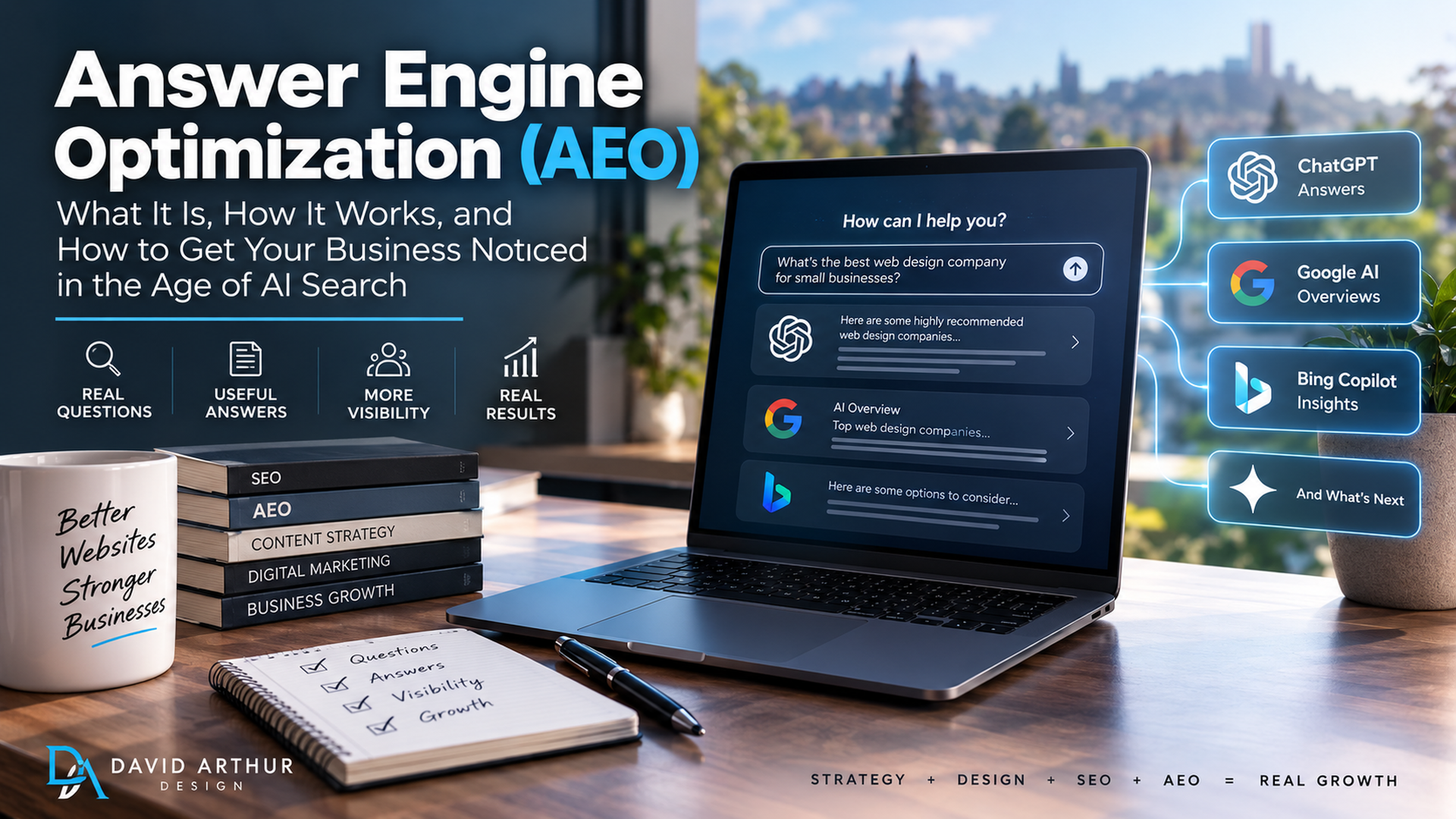
For years, getting found online largely meant getting found on Google. Businesses invested in search engine optimization (SEO) to help their websites rank for the words and phrases potential customers typed into a search box. That still matters—but the way people search for information is changing.
Today, someone looking for a service may not begin by scrolling through a page of traditional search results. They may ask ChatGPT for recommendations, use Google’s AI-powered search experiences to summarize their options, or pose a detailed question to an AI assistant and expect a direct, useful answer. Instead of simply asking a search engine to find pages, users are increasingly asking technology to provide answers.
That shift has created a growing discipline known as Answer Engine Optimization, or AEO.
AEO is often described as the process of making website content easier for AI-powered search systems and answer engines to understand, evaluate, retrieve, and potentially use when constructing an answer. But effective AEO is not simply a matter of adding a few questions and answers to a page or stuffing content with phrases that sound like prompts. It involves many of the same foundations that have always made a website valuable—clear information, strong technical structure, subject-matter depth, credibility, useful original content, and a well-defined relationship between a business and the topics it claims expertise in.
That is also why AEO should not be viewed as a replacement for SEO. Google’s own guidance for generative AI search continues to emphasize that established SEO practices remain relevant because its AI search experiences build on core Search ranking and quality systems. The difference is that businesses now have to think beyond whether a page can rank as a blue link. They also need to consider whether their information is clear and authoritative enough to be understood and surfaced within an AI-generated answer.
For small and midsize businesses, this creates both a challenge and an opportunity. Large brands may have enormous authority and content libraries, but AI-driven discovery can reward pages that answer highly specific questions clearly and demonstrate genuine expertise. A smaller company with focused, well-structured, useful content can therefore compete for visibility in ways that are not limited to traditional rankings alone.
In this guide, we’ll look closely at what Answer Engine Optimization actually means, how it differs from traditional SEO, how AI-powered search systems discover and interpret information, what makes content easier to understand and cite, and what businesses can do now to build visibility as search continues to evolve.
What Is Answer Engine Optimization (AEO)?
Answer Engine Optimization (AEO) is the practice of structuring and improving online content so that search engines, AI-powered search tools, and conversational assistants can clearly understand what a business knows, what it offers, and how its information answers a user’s question.
Traditional SEO has often focused on helping a webpage become one of the best results for a search query. AEO expands that objective. The goal is not only to make a page discoverable, but to make the information within that page sufficiently clear, relevant, trustworthy, and well organized that an answer system can confidently use it when responding to a question.
Consider the difference between these two searches:
“SEO company San Diego”
and:
“How can a small service business improve its chances of appearing in AI-generated search answers?”
The first resembles the keyword-driven searches businesses have optimized for for years. The second is conversational, specific, and asks for an explanation rather than simply a list of websites. Modern search increasingly has to understand these longer, more nuanced questions and assemble information that addresses the user’s underlying intent.
From Ranking Pages to Providing Useful Answers
This is where the idea of an “answer engine” becomes important. A traditional search engine primarily helps a user discover sources. An answer engine attempts to interpret the question, identify relevant information from available sources, and present a useful response directly within the search or conversational experience.
That does not mean websites become unimportant. In many AI-powered search experiences, websites remain the underlying sources from which information is discovered, evaluated, corroborated, and linked. What changes is the path between the user’s question and the website.
A business therefore has to think about more than whether a particular page contains a target keyword. It should also consider questions such as:
- Is the subject of the page immediately clear?
- Does the page directly answer the questions people actually ask?
- Are important concepts explained in language that both people and machines can understand?
- Does the site demonstrate real knowledge of the subject rather than repeating generic information found everywhere else?
- Can search systems determine who the business is, what services it provides, where it operates, and why its information should be considered credible?
- Are related topics connected logically throughout the website?
Those questions sit at the heart of effective AEO.
AEO Is Not a Separate Trick for “Ranking in ChatGPT”
One of the biggest misconceptions surrounding AEO is that there must be a special set of technical tricks that can force an AI platform to mention a business. That is an appealing sales pitch, but it oversimplifies how modern search and AI discovery work.
There is no single “AEO switch” that makes a website appear in AI-generated answers. Different platforms discover, retrieve, rank, and synthesize information in different ways. Their systems also continue to change.
For that reason, a durable AEO strategy focuses less on attempting to manipulate a particular AI system and more on making a business’s information exceptionally easy to discover, interpret, verify, and use.
That means strengthening fundamentals such as site architecture, crawlability, topical depth, internal linking, descriptive headings, useful page structure, accurate business information, structured data where appropriate, original expertise, and clear answers to meaningful questions.
Google has been particularly explicit about this relationship. Its current guidance for generative AI features says that established SEO best practices remain relevant because AI-powered Search experiences are built on Google’s core ranking and quality systems. Google also treats terms such as AEO and GEO as industry terminology rather than entirely separate replacements for SEO.
Good AEO Starts With Information Quality
It is tempting to think of AEO primarily as formatting: write a question, place a concise answer beneath it, add schema markup, and repeat. Clear formatting can certainly help users and machines understand a page, but formatting cannot compensate for weak information.
If ten websites publish essentially the same generic explanation, there is little reason for an answer system to consider the eleventh version uniquely valuable. Strong AEO therefore requires businesses to contribute something useful: first-hand knowledge, practical explanations, examples, original analysis, specific experience, clear comparisons, proprietary information, or insights that genuinely help someone make a decision.
This is especially important as inexpensive AI tools make it possible to publish enormous quantities of superficially polished content. Volume alone is not expertise. In fact, Google’s spam policies specifically address scaled content created primarily to manipulate search rankings rather than help users, regardless of whether that content was produced by AI, humans, or a combination of the two.
The opportunity for legitimate businesses is to move in the opposite direction: publish fewer pieces of shallow content and build stronger resources that demonstrate what the business actually knows.
AEO Is About Becoming an Understandable Source
A useful way to think about Answer Engine Optimization is this:
SEO helps a search system discover and rank your content. AEO helps make the information within that content easier to understand, extract, connect to a question, and potentially use as part of an answer.
The two disciplines overlap heavily. A technically inaccessible website will struggle with both. Thin or inaccurate content will struggle with both. A business whose website gives conflicting information about its services, expertise, or location creates uncertainty for both traditional search systems and AI-driven ones.
Conversely, a site with strong technical SEO, clearly organized services, authoritative supporting articles, consistent business information, useful structured data, meaningful internal links, and genuinely helpful content creates a much stronger foundation for both traditional rankings and answer-driven discovery.
That is why the most effective AEO strategies do not begin by asking, “How do we trick AI into mentioning us?” They begin with a much more useful question:
“How do we make our business one of the clearest, most useful, and most trustworthy sources available for the subjects our customers care about?”
Once that foundation is understood, the next question becomes how AEO differs from traditional SEO—and where the two strategies should work together.
How Is AEO Different From SEO?
Answer Engine Optimization and Search Engine Optimization are closely related, but they emphasize different parts of the discovery process. SEO traditionally focuses on helping webpages become discoverable, indexable, relevant, and competitive in search results. AEO places additional emphasis on making the information within those pages easy for answer systems to interpret, retrieve, and use when responding to a specific question.
The distinction is important, but it should not be exaggerated. AEO does not sit on one side of a line while SEO sits on the other. In practice, a strong AEO strategy is built on a strong SEO foundation.
SEO Optimizes for Discovery; AEO Extends Optimization Into the Answer
Traditional search usually presents users with a collection of results and asks them to choose which source to visit. That makes ranking position, search snippets, page titles, relevance, and click-through behavior extremely important.
AI-driven search can introduce another layer. Instead of merely presenting sources, the system may retrieve information from multiple pages, interpret those sources, and construct a response before the user visits any individual website.
For businesses, this means visibility can increasingly occur at two levels. A page may appear as a conventional search result, but information from that page may also contribute to an AI-generated response or appear as a cited source supporting that response.
Microsoft has already begun exposing this distinction directly to website owners. Bing Webmaster Tools now includes AI Performance reporting that can show when pages are cited in AI-generated answers across supported Microsoft experiences. Google has similarly introduced reporting for visibility within generative AI features in Search.
That development is significant because it gives businesses another way to think about search performance. Rankings and clicks still matter, but citations and visibility within generated answers are becoming measurable parts of online discovery as well.
The Search Query Is Becoming More Conversational
SEO professionals have always studied search intent, but conversational AI makes that intent more explicit. A user is no longer limited to typing a compact phrase such as “brochure designer near me” or “small business SEO services.” They can describe the entire problem:
“I run a small professional-services company and my website ranks reasonably well on Google, but I’m not showing up when people ask AI tools for companies like mine. What should I change?”
That question contains far more context than a conventional keyword. An effective answer may need to address technical SEO, content quality, entity clarity, business information, authority, structured data, internal linking, and how AI systems retrieve supporting sources.
AEO therefore encourages businesses to think beyond isolated keywords and build content around subjects, relationships, customer questions, and real-world problems. Keywords remain useful because they reveal demand and language, but they become part of a larger understanding of intent rather than the entire strategy.
SEO and AEO Share the Same Foundation
Many of the elements that improve traditional organic search visibility also create a stronger foundation for AI-driven discovery. These include crawlable pages, sensible site architecture, descriptive titles and headings, useful internal links, original content, clear authorship or business identity where appropriate, accurate information, fast and accessible pages, and structured data that accurately represents visible content.
Google’s guidance for its generative AI search features is especially clear on this point: pages do not need a special AI schema or separate machine-readable file to qualify for AI Overviews or AI Mode. Pages still need to be indexed and eligible for Google Search, and Google’s established SEO best practices continue to apply.
In other words, abandoning SEO in favor of a completely separate “AI optimization” strategy would be a mistake. If search systems cannot efficiently crawl, index, understand, and trust the website, there is little foundation for an answer engine to work with.
Where AEO Adds a Different Emphasis
Where AEO becomes particularly useful is in how content is written and organized after those foundations are in place.
A page designed only around a broad keyword might discuss a topic extensively without ever giving a concise answer to the specific questions customers ask. AEO encourages clearer relationships between questions and answers, stronger definitions, descriptive headings, useful comparisons, supporting evidence, and enough context for an extracted passage to remain understandable even when it appears outside the full page.
For example, a website designer could create a page targeting “website design services.” Traditional SEO work might focus on the service description, title tag, internal links, local relevance, page experience, backlinks, and related signals. An AEO-minded content strategy would retain those elements while also answering questions such as:
- How much should a professionally designed small-business website cost?
- What should be included in a website design package?
- How long does a typical WordPress website take to build?
- What is the difference between a template website and a custom-designed website?
- How should SEO be incorporated during the website design process?
Those are not questions added merely to create an FAQ block. Each represents a distinct information need and an opportunity to demonstrate expertise.
AEO Can Expand What “Visibility” Means
With traditional SEO, success is often discussed in terms of rankings, impressions, organic traffic, leads, and conversions. Those remain essential metrics. AEO adds another potential layer: whether a company’s information is being surfaced or cited within answer-driven experiences.
That does not mean every AI citation will produce a website visit. Sometimes the answer itself may satisfy the user’s immediate question. But a citation can still introduce a brand, reinforce expertise, and place a business in front of a prospective customer during the research process.
This also makes measurement more nuanced. Businesses should continue monitoring conventional search performance while paying attention to the new reporting tools search platforms are beginning to provide for AI visibility. The objective should not be to chase citations for their own sake, but to understand whether the business is becoming a recognized source for topics that matter to its customers.
SEO and AEO Should Work Together
The most practical approach is not to choose between SEO and AEO. It is to build a search strategy capable of serving both.
SEO provides the technical and strategic foundation that helps content become discoverable and competitive. AEO builds on that foundation by making the information more useful in an environment where search systems increasingly interpret questions and assemble answers.
A business that does this well is not creating one website for Google and another for AI. It is creating a single, coherent source of useful information that can perform across traditional search results, AI-generated search experiences, and conversational discovery.
Understanding that relationship leads to the next important question: how do AI-powered answer engines actually find, interpret, and select information from websites?
How Do AI Answer Engines Find and Use Website Content?
To understand AEO, it helps to understand what happens between a user asking a question and an AI-powered system producing an answer. The exact process differs from platform to platform, and the underlying systems are constantly evolving, but one principle is consistent: useful website content first has to be discoverable before it can become a useful source.
That makes AEO partly a content discipline and partly a technical one. A beautifully written article cannot contribute much if a search system cannot crawl or index it. Likewise, a perfectly crawlable page offers little value if the information is vague, generic, outdated, or unrelated to the question being asked.
Step 1: The Content Has to Be Discoverable
Before an answer engine can use information from a website, there needs to be a path to that information. For search-based systems, this often begins with crawling and indexing.
Google states that pages used as supporting links in its generative AI Search experiences must be indexed and eligible to appear in Google Search with a snippet. OpenAI similarly provides a search crawler, OAI-SearchBot, and advises publishers who want their public content to be discoverable and cited in ChatGPT search not to block that crawler.
This is why technical details that may seem unrelated to AI can matter enormously. Robots directives, accidental noindex tags, broken internal links, inaccessible navigation, server errors, aggressive bot protection, and poorly configured firewalls can all interfere with discovery.
AEO therefore begins much earlier than the writing of an FAQ. It begins with making sure the website can actually be reached and understood by the systems a business wants to appear in.
Step 2: The System Has to Understand the Question
Modern AI search systems are designed to interpret meaning rather than simply match a string of words. A user can ask a detailed question containing several needs at once, and the system may break that request into related concepts before searching for supporting information.
Google describes one technique used by AI Overviews and AI Mode as query fan-out. Instead of treating a complex question as a single search, the system can issue multiple related searches across subtopics and data sources. The results can then help construct a more comprehensive response.
Imagine someone asks:
“What should a small law firm do to make its website more likely to appear in AI search results without hurting its existing Google rankings?”
A system trying to answer that well may need information about traditional SEO, AI search visibility, technical indexing, structured data, content quality, local business signals, authority, and measurement. The best supporting source may therefore be a page that explains the broader subject thoroughly rather than a page built around an exact-match version of that sentence.
This is one reason modern optimization should not revolve around creating a separate page for every conceivable wording of a question. Search systems have become much better at understanding semantic relationships and matching relevant information even when the words are not identical.
Step 3: Relevant Information Is Retrieved
Once the system has interpreted the question, it needs useful information with which to construct the answer. One common approach is known as retrieval-augmented generation (RAG), sometimes described as grounding.
Rather than relying only on information contained within an AI model, a retrieval system can locate current external sources related to the question and provide that information to the model as context. Google describes its generative AI Search experiences as using its core Search ranking systems to retrieve relevant, up-to-date pages from the Search index and then reviewing specific information from those pages when generating a response.
This distinction matters for businesses. The objective is not merely to have words somewhere on a website. The information needs to be relevant enough to the question and accessible enough to be retrieved when the system looks for supporting material.
Step 4: The System Evaluates Passages, Context, and Supporting Sources
An AI-generated answer does not necessarily treat every page as one indivisible document. A long, detailed resource may contain one section that is particularly relevant to a user’s question. Clear headings, coherent paragraphs, descriptive language, and logical organization make it easier for both readers and automated systems to understand what individual sections are about.
This does not mean every paragraph should be artificially shortened into a tiny “AI-friendly chunk.” Google specifically cautions that there is no requirement to break content into tiny pieces for generative AI. The better principle is to organize information naturally for people: one idea should lead logically to the next, headings should accurately describe the material beneath them, and important answers should not be buried beneath unnecessary filler.
Context is equally important. A sentence such as “It usually takes four to six weeks” may be perfectly understandable to someone reading the previous three paragraphs, but it becomes ambiguous when separated from them. A clearer statement—such as “A typical five- to ten-page small-business WordPress website may take four to six weeks to design and develop, depending on content readiness and revisions”—carries useful context with it.
Writing this way is not about feeding machines awkwardly constructed sentences. It is simply precise communication, and precision benefits human readers as much as answer systems.
Step 5: Sources May Be Cited or Linked
When an answer system uses web information, it may provide links or citations that allow users to explore the supporting sources. This is one of the most important opportunities AEO creates for businesses.
A citation does not necessarily mean the entire answer came from one website. AI systems can synthesize information from multiple sources. A company’s page might support one definition, comparison, statistic, recommendation, or explanation within a much larger response.
For ChatGPT search specifically, OpenAI says public websites can appear in search results and recommends allowing OAI-SearchBot so content can be discovered, surfaced, cited, and linked. OpenAI also notes that referral links from ChatGPT search include tracking information that publishers can use to identify inbound ChatGPT traffic in analytics platforms.
This makes AI visibility something businesses can increasingly observe rather than treat as an abstract concept. Citations, referral traffic, search-platform AI reports, branded searches, assisted conversions, and leads that mention AI discovery can all contribute pieces of the measurement picture.
Why Clear Topical Relationships Matter
Answer engines also benefit from understanding how information across a website relates. A single article about AEO is useful, but a site becomes more informative when that article connects naturally to relevant service pages and supporting resources about SEO, website design, structured data, content strategy, local search, and related subjects.
Internal linking helps users navigate those relationships and helps search engines discover and understand related pages. Descriptive anchor text provides additional context about what the destination page contains.
This is one reason a strong content strategy resembles a knowledge system more than a pile of disconnected blog posts. Each important service should have a clear primary page, and supporting articles should expand on the questions, problems, comparisons, and decisions associated with that service.
There Is No Guaranteed Citation Formula
Perhaps the most important point is that none of these practices guarantees inclusion in an AI-generated answer. Google explicitly states that meeting its technical requirements and best practices does not guarantee crawling, indexing, or serving. OpenAI likewise notes that placement in ChatGPT search is not guaranteed.
That uncertainty is important when evaluating AEO services. Any company promising guaranteed placement in ChatGPT, AI Overviews, or another answer engine should be approached carefully. These are dynamic systems whose results can change based on the question, context, available sources, model, location, freshness of information, and platform.
A credible AEO strategy therefore focuses on improving the conditions that make visibility possible: strong technical accessibility, clear business identity, useful and original information, logical site structure, topical depth, accurate supporting data, and content that genuinely deserves to be referenced.
Once a business understands how information can move from a webpage into an AI-generated response, the practical question becomes much clearer: what characteristics make a piece of content more useful to answer engines in the first place?
What Makes Content More Useful to Answer Engines?
There is no universal checklist that guarantees an AI system will cite a particular page. However, the characteristics that make content genuinely useful to people also tend to make it easier for search and answer systems to interpret. The goal is not to write for a machine at the expense of the reader. It is to remove ambiguity, demonstrate real knowledge, and organize information so that its meaning is clear.
Answer the Question Clearly Before Expanding on It
One of the simplest improvements a business can make is to answer important questions directly. If a section is titled “What Is Answer Engine Optimization?” the reader should not have to work through six paragraphs of background before receiving a definition.
A strong page can provide a concise answer first and then add the context, examples, qualifications, and detail needed to make that answer genuinely useful. This approach serves impatient readers while still giving researchers—and retrieval systems—substantive information to work with.
Direct does not mean simplistic. Some questions require nuance. The objective is to make the central answer identifiable without stripping away the details that make it accurate.
Demonstrate Experience Instead of Repeating Generic Information
As AI makes basic content inexpensive to produce, generic explanations become easier to duplicate. A business can differentiate its content by adding knowledge that comes from actually doing the work.
A website designer, for example, can explain which information clients frequently fail to prepare before a project begins, how those delays affect a launch schedule, or why certain design decisions create problems later when SEO is introduced. A print professional can discuss production tolerances, finishing choices, file preparation, or common mistakes that only become obvious after years of sending jobs to press.
Those details are valuable because they move the content beyond a rewritten definition. They demonstrate that there is real experience behind the information.
Cover the Subject Deeply Enough to Satisfy the User’s Intent
Content length by itself is not a quality signal. A 3,000-word article filled with repetition is not automatically better than a focused 1,200-word article. At the same time, complex questions often cannot be answered responsibly in a few shallow paragraphs.
The better standard is completeness. Does the page answer the main question? Does it anticipate the logical follow-up questions? Does it explain important exceptions? Does it help the reader understand what to do next?
This is where topical depth becomes useful. Rather than stretching one page indefinitely, a business can create a strong primary resource and support it with related pages that explore individual subjects in greater detail. Internal links then connect those resources into a coherent body of knowledge.
Use Descriptive Headings and Logical Structure
Headings should tell readers what the next section actually discusses. Clever headlines can be effective in advertising, but informational content benefits from clarity.
A heading such as “Why Structured Data Matters” communicates far more than a vague heading such as “The Secret Ingredient.” Clear headings improve scanning, accessibility, and comprehension, and they provide additional context about the relationship between sections of a page.
The hierarchy matters as well. A primary topic should contain logically related subtopics rather than a random sequence of keyword-inspired headings. When the structure makes sense to a person reading the article from top to bottom, it is generally easier for automated systems to interpret as well.
Make Important Facts Specific and Self-Contained
Specificity makes information more useful. Statements should identify what they refer to, particularly when a passage could be separated from the surrounding page.
Instead of writing, “This can improve your results,” explain what “this” means and which results may improve. Instead of saying, “They recommend using it,” identify who “they” are and what is being recommended.
This is particularly important when discussing statistics, studies, policies, technical requirements, or platform guidance. Name the source, provide appropriate context, and avoid presenting an old statistic as though it describes current conditions.
Use Structured Data to Clarify Meaning—Not Manufacture Authority
Structured data can help search engines understand specific information about a page, an organization, an article, a product, a local business, a breadcrumb trail, and other supported entities. It is useful because it expresses certain information in a standardized machine-readable format.
But schema markup should describe what is actually present and true on the page. It does not turn weak content into authoritative content, and adding every available schema type does not create an AEO advantage by itself.
For a business website, the appropriate structured data may include Organization or LocalBusiness information, Article or BlogPosting markup for editorial content, BreadcrumbList markup for navigation, and other types that genuinely match the visible content and business model.
Strengthen Entity and Business Clarity
An answer system should not have to guess who is responsible for the information on a website. Business names, services, locations, authorship, contact information, and organizational relationships should be consistent and understandable.
This is sometimes discussed as “entity optimization.” The phrase can sound technical, but the practical idea is straightforward: make it easy to determine that a particular business is a real organization, that it offers specific services, that its pages belong to the same organization, and that relevant information about the business is consistent across the web.
An informative About page, clearly defined service pages, accurate contact information, appropriate organization markup, consistent business profiles, and identifiable authorship where it adds value can all contribute to that clarity.
Build Meaningful Internal Links
Internal links do more than move visitors from one page to another. They establish relationships between subjects.
An article explaining AEO might naturally link to a company’s SEO and AEO service page. A section about website structure might link to its website design service. A discussion of visual communication might connect to branding or graphic design resources.
The anchor text should describe the destination naturally rather than relying repeatedly on generic phrases such as “click here.” This helps readers decide whether the linked page is useful and gives search systems additional context about how the site’s topics relate.
Keep Important Information Accurate and Current
AI search changes quickly. Features, crawler behavior, reporting tools, schema support, and platform terminology can change within months. Content about AEO therefore requires maintenance.
For example, Google removed its FAQ rich-result documentation in June 2026 after discontinuing the FAQ rich result in Search. That does not mean frequently asked questions stopped being useful to readers, nor does it mean FAQ content should disappear. It means marketers should distinguish between creating useful question-and-answer content and assuming that FAQ markup will produce a particular Google search feature.
Similarly, publishers interested in ChatGPT search should periodically verify OpenAI’s current crawler guidance rather than relying indefinitely on an old optimization checklist. OpenAI currently advises publishers to allow OAI-SearchBot if they want their public content to be discoverable for summaries, snippets, citations, and links in ChatGPT search.
Write for People First, but Make the Meaning Easy to Extract
The best AEO content should not sound as though it was written for a robot. It should sound knowledgeable, specific, and useful.
That means avoiding awkward keyword repetition, hundreds of nearly identical question pages, unnecessary definitions inserted solely for search engines, and paragraphs that repeat the same idea in slightly different language to increase word count.
A better approach is to combine human expertise with strong information architecture: answer important questions directly, explain them thoroughly, organize related ideas logically, identify sources where appropriate, and make important statements precise enough to stand on their own.
When these elements work together, AEO becomes less about chasing an algorithm and more about building a website that functions as a dependable source of information. The next layer is technical: which website and SEO elements help answer engines discover, interpret, and trust that information?
The Technical Side of AEO: What Your Website Needs
Strong content is essential, but content cannot contribute to search or AI-driven discovery if technical barriers prevent systems from reaching it. This is where the technical side of AEO overlaps heavily with technical SEO.
The good news is that businesses generally do not need to build a separate website for AI or install a mysterious “AEO technology stack.” Most of the technical work involves making the existing website accessible, indexable, logically organized, fast enough to use comfortably, and explicit about what its pages contain.
Make Sure Important Pages Can Be Crawled and Indexed
The first technical requirement is basic but critical: pages intended to attract search visibility should be accessible to the relevant crawlers and eligible for indexing.
A robots.txt rule can prevent a crawler from accessing sections of a site. A noindex directive can tell a search engine not to index a page. Authentication, server errors, security tools, firewall rules, bot protection, and JavaScript challenges can also prevent automated systems from retrieving content.
These controls are useful when intentional. Problems arise when an important service page or article is blocked accidentally.
Google recommends using Search Console’s URL Inspection tools to verify that important pages are accessible and rendered correctly. Publishers interested in ChatGPT search should also make sure they are not unintentionally blocking OAI-SearchBot. OpenAI currently states that allowing OAI-SearchBot helps public content become eligible for discovery, summaries, snippets, citations, and links in ChatGPT search.
Understand the Difference Between AI Search Crawlers and Training Crawlers
One area that causes unnecessary confusion is the assumption that allowing an AI company to discover a website for search automatically means allowing the same content to be used for model training.
OpenAI, for example, distinguishes between OAI-SearchBot, which is associated with search discovery, and GPTBot, which publishers can block when they want to exclude content from potential model training. These controls serve different purposes.
For a business pursuing AEO, that distinction matters. A site owner may want public pages discoverable in ChatGPT search while making a different decision about training access. Robots directives should therefore be configured deliberately rather than blocking every unfamiliar AI-related user agent by default.
Use XML Sitemaps as a Discovery Aid
An XML sitemap provides search engines with a structured list of URLs a website considers important. It does not guarantee indexing or ranking, but it can make discovery more efficient and help search engines identify new or updated pages.
For a WordPress website, SEO plugins commonly generate XML sitemaps automatically. The important part is verifying that the sitemap contains the pages that should be indexed, excludes URLs that should not be promoted, remains accessible, and is submitted to the appropriate webmaster tools where useful.
A sitemap should support good site architecture, not replace it. Important pages should still be reachable through normal internal navigation and contextual links.
Keep Canonical URLs Clear
Websites sometimes make substantially the same content available through multiple URLs. Tracking parameters, archive structures, HTTP and HTTPS versions, trailing-slash variations, print versions, and other technical configurations can create duplicate or near-duplicate pages.
Canonicalization helps search engines understand which URL should be treated as the primary version. Google considers several signals when choosing a canonical URL, including redirects, sitemap inclusion, and rel=”canonical” annotations.
Clear canonicalization matters because a business wants authority, links, indexing signals, and measurement centered on the intended version of a page rather than fragmented across unnecessary duplicates.
Make Important Content Available in the Rendered Page
Modern search engines can process JavaScript, but unnecessary complexity can still create problems. Important information should not depend on fragile interactions, broken scripts, or conditions that prevent crawlers from receiving the meaningful page content.
JavaScript-heavy websites should be tested to make sure search engines can render the content users see. This is particularly important for navigation, internal links, product or service descriptions, headings, and other information central to understanding the page.
Google’s documentation also warns site owners to be careful with JavaScript-generated canonical and noindex directives because indexing and canonicalization decisions can occur at different stages of crawling and rendering.
Use Structured Data Accurately
Structured data can reinforce explicit information about a page or organization in a standardized format. Depending on the website, appropriate markup might describe an Organization, LocalBusiness, Article, Product, BreadcrumbList, Event, or another supported entity.
The key word is accurately. Structured data should agree with the visible page and represent the entity or content honestly. Adding unrelated schema types or stuffing markup with claims that are not supported by the page is not a shortcut to AI visibility.
For AEO, structured data is best viewed as clarification. It can help machines interpret information that already exists; it does not replace the need for strong content and clear site structure.
Create a Logical Site Architecture
A technically sound website should make its important subjects easy to navigate. Core services deserve clear service pages. Supporting articles should connect to those pages where relevant, and related resources should link to one another naturally.
This architecture helps a visitor understand the business, but it also gives search systems contextual clues. If a website has a primary SEO and AEO service page supported by detailed articles about AI search, structured data, local SEO, content strategy, and website optimization, the relationship among those pages helps define the site’s subject matter more clearly.
Good architecture also prevents useful information from becoming “orphaned”—published on the site but disconnected from normal navigation and internal links.
Page Performance Still Matters
AEO should not become an excuse to ignore the user experience. Pages that are painfully slow, unstable, difficult to use on mobile devices, or overloaded with intrusive elements create a poor experience regardless of how well the copy is optimized.
Performance improvements can also make crawling and rendering more efficient. Image optimization, sensible caching, reliable hosting, efficient code, and restraint with unnecessary scripts all contribute to a healthier website.
Core Web Vitals and other performance measurements should therefore be treated as part of an overall technical strategy rather than as a special AEO ranking formula.
Accessibility Can Improve Machine Clarity Too
Many accessibility practices also create clearer machine-readable structure. Descriptive link text, meaningful headings, useful alternative text for informative images, properly labeled forms, semantic HTML, and appropriate ARIA attributes make interfaces easier to understand.
OpenAI specifically recommends following WAI-ARIA best practices for interactive elements when improving compatibility with ChatGPT’s agent experiences. The broader lesson is useful beyond any one platform: websites built with clear semantic structure tend to be easier for people, assistive technology, search engines, and automated systems to navigate.
Do Not Confuse Technical AEO With Technical Theater
As interest in AI search grows, businesses are increasingly being sold technical solutions that promise to “unlock” AI visibility through a special file, proprietary schema, hidden prompt, or one-time configuration.
Some emerging standards may eventually become useful, and technical practices will continue to evolve. But businesses should distinguish experimentation from established requirements.
Google currently says there is no special AI schema or additional machine-readable file required to appear in its generative AI Search features. OpenAI’s current publisher guidance emphasizes crawler accessibility, particularly OAI-SearchBot, rather than a secret optimization format.
A sensible technical AEO strategy therefore concentrates first on the things that can be verified: crawl access, indexing, clean canonicalization, XML sitemaps, accurate structured data, understandable architecture, internal linking, usable performance, accessible markup, and content that renders reliably.
Once those technical foundations are in place, businesses can turn to another important part of answer-engine visibility: authority, trust, and the signals that help establish why a particular business or source deserves to be referenced.
Authority, Trust, and Why Answer Engines Choose Certain Sources
Making content accessible and easy to understand solves only part of the AEO problem. An answer system may discover dozens—or thousands—of pages that discuss the same subject. It still has to determine which information is useful enough to rely on.
This is where authority and trust become important. There is no publicly documented universal “AI authority score,” and businesses should be skeptical of anyone claiming to know a secret formula. Instead, authority is better understood as the cumulative result of many signals that help establish whether a source appears knowledgeable, consistent, reputable, and appropriate for the question being answered.
Understanding E-E-A-T Without Turning It Into a Score
Google frequently discusses Experience, Expertise, Authoritativeness, and Trustworthiness—E-E-A-T—when explaining how people should think about content quality. Trust is central to that framework.
E-E-A-T should not be treated as a single metric that can be checked in an SEO plugin or raised from 72 to 85 by adding an author box. It is a framework for evaluating whether content gives users good reasons to trust the information and the people or organization behind it.
For a business website, that can mean showing genuine first-hand experience, accurately describing services, identifying who is responsible for the content, supporting factual claims, maintaining consistent business information, and avoiding exaggerated promises that cannot be substantiated.
First-Hand Experience Can Be a Competitive Advantage
One of the strongest assets a legitimate business has is experience that generic content publishers do not.
A graphic designer who has prepared thousands of files for commercial printing can explain why certain artwork fails at press. A WordPress professional who has inherited poorly constructed websites can describe the structural problems that make future SEO difficult. A marketing specialist who has watched search evolve can explain how client questions and discovery patterns have changed.
Those observations are difficult to reproduce convincingly without doing the work. Including specific examples, processes, limitations, lessons, and practical recommendations can therefore make business content more distinctive and more useful.
This does not require turning every article into a personal story. It means allowing genuine expertise to influence the substance of the page.
Make It Clear Who Is Behind the Information
Anonymous content can sometimes be useful, but business websites usually benefit from transparency. Visitors should be able to determine who the company is, what it does, how to contact it, and—where relevant—who created or reviewed specialized content.
A strong About page, accurate service descriptions, consistent contact information, professional profiles, author information where appropriate, and links to supporting credentials or work can provide context that a bare article cannot.
The purpose is not to decorate pages with artificial trust badges. It is to make legitimate expertise verifiable.
Support Claims With Reliable Sources
When an article makes factual claims about another platform, regulation, study, statistic, or industry standard, linking to a reliable primary source can strengthen the usefulness of the content.
For example, an AEO article explaining Google’s requirements should refer to Google’s current documentation rather than relying entirely on another marketing blog’s interpretation of it. Information about ChatGPT search should likewise distinguish OpenAI’s published guidance from speculation by outside marketers.
Original analysis can then be layered on top of those sources. This combination—verifiable facts plus useful interpretation—is often more valuable than simply repeating what another article has already said.
Third-Party Mentions and Links Still Matter
A business cannot establish its entire reputation through claims made on its own website. Independent references can provide additional context.
Relevant backlinks, professional associations, news coverage, industry directories, interviews, awards, customer reviews, citations, and mentions on reputable third-party sites can all contribute to a broader picture of a business or individual.
That does not mean businesses should purchase large quantities of links or manufacture mentions. Google’s spam policies continue to prohibit link schemes and other practices intended primarily to manipulate ranking systems, including attempts to manipulate generative AI responses in Google Search.
The healthier objective is to earn references because the business has done something worth referencing: produced useful research, contributed expertise, completed notable work, participated in its professional community, or published resources people genuinely want to share.
Consistency Helps Establish Entity Clarity
Search and answer systems often encounter information about a business across many locations: its website, social profiles, business listings, directories, articles, reviews, interviews, and other third-party sources.
Major inconsistencies can create ambiguity. If a company uses several different names, lists conflicting locations, describes unrelated service offerings, or has outdated profiles across the web, automated systems and potential customers have more work to do to determine what is accurate.
Consistency does not mean every description must be identical. It means the core facts about the business should agree: its name, primary services, website, location or service area where relevant, contact information, and professional identity.
Topical Authority Is Built Through Relationships, Not Article Count
Publishing fifty articles containing the phrase “Answer Engine Optimization” does not automatically make a website authoritative about AEO.
A more credible approach is to build a connected body of useful information. A primary SEO and AEO service page might be supported by resources explaining AI search, structured data, local SEO, website architecture, content strategy, analytics, and related subjects. Those resources should link naturally to one another and, importantly, should reflect services and expertise the business actually provides.
This creates depth without manufacturing pages solely to occupy search results. It also gives visitors multiple ways to explore a subject according to how much information they need.
Reputation Cannot Be Manufactured With Schema
Structured data can identify an organization, person, article, product, review, or other entity, but markup is not proof that the underlying claim is trustworthy.
Adding Organization schema does not make an organization authoritative. Adding Person schema does not establish expertise. Review markup does not substitute for genuine customer experiences.
Schema should accurately communicate facts that are already supported by the website. Authority has to come from the substance behind those facts.
Trust Is Especially Important When the Stakes Are High
The importance of reliable sourcing increases when content could significantly affect a person’s health, financial stability, safety, or other major life decisions. Google refers to these as “Your Money or Your Life,” or YMYL, topics and applies particularly strong expectations around trust in its quality guidance.
AEO strategies for attorneys, medical professionals, financial businesses, and other high-stakes industries therefore need additional care. Content should distinguish general education from professional advice, avoid unsupported guarantees, identify appropriate qualifications, and rely on authoritative sources when discussing consequential facts.
The objective should never be to make content merely look authoritative enough for an algorithm. It should actually be responsible enough for a person to rely on.
Authority Is Earned Over Time
One of the less exciting realities of both SEO and AEO is that genuine authority usually develops gradually. A business publishes useful information, earns mentions and links, accumulates reviews and examples of its work, keeps its information accurate, expands its knowledge base, and establishes a consistent presence around the subjects it knows well.
That process is harder to package as a one-click optimization service, but it is also far more durable.
For businesses evaluating AEO, the practical takeaway is straightforward: do not ask only whether your website contains the right keywords or technical markup. Ask whether someone encountering your business for the first time would find enough evidence to understand who you are, what you know, what you have actually done, and why your information deserves to be trusted.
With content quality, technical accessibility, and authority working together, the next step is to examine how these principles apply specifically to local and service-based businesses competing for visibility in AI-driven search.
AEO for Local and Service-Based Businesses
Answer Engine Optimization can be especially important for local and service-based businesses because many customer questions combine two different needs: information and selection. Someone may want to understand a problem while also trying to determine which company is appropriate to hire.
A homeowner might ask an AI assistant, “What should I look for when hiring a contractor to repair water damage?” and then follow with, “Which companies near me specialize in this?” A business owner might ask, “Do I need SEO and AEO for a new website?” before asking for agencies that provide both services.
These conversations blur the traditional line between informational search and commercial search. A local AEO strategy should therefore help answer systems understand both what the business knows and what the business actually does.
Start With a Clearly Defined Business
A service business should make its basic identity unmistakable. The website should clearly communicate the business name, primary services, geographic market or service area where relevant, contact methods, and the relationship between its individual service pages.
This sounds elementary, but many small-business websites use vague marketing language that makes the actual offering surprisingly difficult to determine. A homepage may promise “innovative solutions that transform your vision” without clearly stating that the company designs WordPress websites, provides SEO services, or produces commercial printing.
Clear language helps customers immediately understand the company, and it gives search systems more concrete information with which to associate the business.
Build Strong Individual Service Pages
A list of services on the homepage is useful for orientation, but important services generally deserve their own substantial pages. A dedicated page gives a business room to explain what the service includes, who it is for, how the process works, what problems it solves, and which questions customers commonly ask before purchasing.
For example, an SEO and AEO service page can explain traditional search optimization, AI-search considerations, technical auditing, content development, structured data, internal linking, measurement, and how the strategy changes according to the client’s market.
Supporting articles can then explore individual questions in greater depth and link back to the primary service page. This creates a clear relationship between informational expertise and the commercial service being offered.
Keep Google Business Profile Information Accurate
For businesses that qualify for a Google Business Profile, the profile remains an important source of local business information. Google recommends keeping details such as the business name, category, address or service area, hours, phone number, and other profile information accurate and complete.
This matters beyond a single map listing. Local discovery depends on search systems understanding what a business is, where it operates, and whether it is relevant to the user’s request.
Service-area businesses should be particularly careful not to create misleading locations simply to target additional cities. AEO does not change the underlying requirement that business information should represent the real company accurately.
Reviews Provide Context That the Business Cannot Write About Itself
Customer reviews can reveal information that ordinary service pages do not. They may describe the type of project completed, the customer’s experience, communication, turnaround, professionalism, or the specific problem the business solved.
That makes reviews valuable not only as social proof but as independent descriptive information about the business.
Businesses should encourage genuine customers to leave honest reviews and should respond professionally where appropriate. They should not attempt to manufacture reviews or instruct customers to fill them with predetermined keywords. Authenticity is more valuable than forcing every review to sound like an SEO paragraph.
Local Citations Should Reinforce Core Business Facts
Business directories, professional associations, chambers of commerce, industry profiles, social platforms, and other legitimate listings can reinforce core information about a company.
The objective is not to submit a business to hundreds of low-quality directories. It is to maintain accurate profiles on platforms that customers or search systems may reasonably use to verify the business.
Consistency matters most for foundational information such as the business name, website, contact information, and location or service area. Minor differences in wording are normal; conflicting facts are the larger concern.
Create Local Content Only When There Is Something Useful to Say
Location pages can be valuable when a business genuinely serves multiple markets and can provide useful information relevant to each area. They become less valuable when dozens of city pages contain essentially identical copy with only the city name replaced.
Google’s spam policies specifically address scaled content created primarily to manipulate search rankings. For AEO, repetitive location pages also provide little distinctive information for an answer system to use.
A strong local page might explain services available in the area, relevant project experience, geographic considerations, service limitations, local processes, or questions that genuinely differ by market. If there is no meaningful difference to discuss, creating another near-duplicate page simply to target a place name may not improve the site.
Think About the Questions Customers Ask Before They Hire
Local AEO becomes particularly useful when businesses document the questions they hear repeatedly during actual sales conversations.
A prospective client may ask:
- Do you work with businesses outside your immediate area?
- How much does the service typically cost?
- How long does the process take?
- What information do you need from me before we start?
- Do you handle the entire project or only one part of it?
- What happens after the project launches?
- How is your service different from using a low-cost automated platform?
These questions reveal real customer intent. Answering them thoroughly on the appropriate service pages or supporting articles can improve the website for human visitors while also creating clear information that answer systems can retrieve.
Connect Local Expertise to Evidence
A business claiming local experience should support that claim where possible. Project examples, case studies, testimonials, portfolio pieces, photographs of completed work, local partnerships, community involvement, and specific knowledge of the market can make a location claim more meaningful.
For professional-service businesses, this might include discussing local regulations or processes where relevant and appropriate. For designers, contractors, photographers, event companies, and similar businesses, the portfolio itself may provide useful evidence of work performed in the market.
The principle is simple: do not merely tell search systems that the company is experienced in an area. Give customers enough information to see that experience for themselves.
Do Not Assume “Near Me” Optimization Is a Keyword Exercise
Businesses sometimes try to optimize for local intent by repeatedly inserting phrases such as “near me” into page copy. But when a person searches or asks for a business “near me,” the important variable is the searcher’s location and the system’s understanding of relevant nearby businesses—not whether a webpage repeats the literal phrase dozens of times.
A stronger local strategy focuses on accurate location and service-area information, appropriate business categories, useful service pages, reputation, locally relevant content, and consistent business data.
AI Discovery Can Extend Beyond the Immediate Click
Local businesses should also recognize that AI-driven discovery may influence a customer before the website visit occurs. An answer might mention several approaches, cite a business resource, summarize considerations, or introduce a company name that the user later searches directly.
This means attribution may become less linear. A customer could first encounter a business through an AI answer, later view its Google Business Profile, visit the website through branded search, and finally call or submit a form.
Businesses should therefore look at AEO as part of the broader customer journey rather than expecting every AI interaction to produce an immediately measurable referral click.
For local and service-based companies, the strongest strategy is ultimately the same one that benefits customers: make the business easy to identify, explain services clearly, maintain accurate information, demonstrate genuine experience, earn authentic reputation signals, and answer the questions people actually ask.
With those foundations established, it becomes easier to recognize the opposite side of the equation: the common AEO mistakes that can waste time, dilute a website’s quality, or create unrealistic expectations about AI visibility.
Common AEO Mistakes Businesses Should Avoid
As Answer Engine Optimization becomes more visible, businesses are being presented with an increasing number of shortcuts, formulas, and guaranteed solutions. Some recommendations are simply traditional SEO practices given a new label. Others are based on reasonable experiments but presented as established facts. And some can actively weaken a website.
A practical AEO strategy requires separating useful optimization from activity that merely looks sophisticated.
Treating AEO as a Replacement for SEO
One of the biggest mistakes is assuming traditional SEO is becoming obsolete because people are using AI-powered search. In reality, many answer experiences still depend heavily on search infrastructure, crawling, indexing, ranking systems, and web content.
Google explicitly states that its existing SEO best practices remain relevant to AI features in Search. A website with serious technical SEO problems does not become competitive simply because an AEO plugin or AI-content strategy is added on top.
Businesses should therefore treat AEO as an extension of modern search optimization, not an excuse to abandon the fundamentals.
Publishing Large Volumes of Generic AI Content
Generative AI can dramatically accelerate research, outlining, editing, and content production. Used thoughtfully, it can be an excellent tool. Problems begin when speed becomes the strategy.
Publishing hundreds of articles that merely rephrase information already available elsewhere does little to demonstrate expertise. It can also create a bloated website full of overlapping pages competing with one another.
Google’s spam policies address scaled content abuse when many pages are generated primarily to manipulate rankings rather than help users, regardless of whether the pages were created by humans, automation, AI, or a combination of methods.
The better use of AI is to assist knowledgeable people in creating stronger content—not to replace knowledge with volume.
Writing for AI Instead of Writing for Customers
AEO advice sometimes encourages unnatural writing: repeat the question verbatim, answer every paragraph in a rigid formula, force entity names into sentences, and structure every page as though it were a database record.
Clarity is useful. Robotic writing is not.
The primary audience is still the prospective customer. Content should be readable, persuasive where appropriate, accurate, and genuinely informative. Good headings and direct answers can make that information easier for machines to interpret without making the page unpleasant for humans.
Creating an FAQ for Every Possible Keyword
Frequently asked questions are useful when they reflect questions customers genuinely have. They become less useful when dozens of nearly identical questions are created solely to capture wording variations.
For example, a page does not need separate answers for “What is AEO?”, “What does AEO mean?”, “What is the meaning of AEO?”, and “Can you explain AEO?” simply because each phrase may appear in keyword research.
A single strong definition followed by meaningful supporting questions creates a better resource.
Assuming Schema Markup Guarantees AI Visibility
Structured data is valuable when it accurately describes content and entities, but schema is not a direct ticket into an AI answer.
Adding Organization, Article, Person, or other markup does not prove expertise. Adding unsupported properties does not make a business more authoritative. And using schema types that do not accurately correspond to visible page content can create misleading markup.
Use structured data because it clarifies legitimate information—not because someone claims a particular schema property is a secret AI-ranking factor.
Building Thin Location Pages at Scale
Service businesses often want visibility across many cities. That can lead to a template in which the same page is reproduced dozens of times and only the location name changes.
If a business genuinely serves multiple areas, location-specific content can be useful. But each page should have a reason to exist. Relevant projects, service differences, local considerations, customer questions, geographic context, or other meaningful information can make a page distinct.
Creating hundreds of nearly identical pages primarily to occupy more search results risks producing scaled, low-value content rather than useful local resources.
Ignoring Crawl and Indexing Controls
Another mistake is investing heavily in content while overlooking whether answer and search systems can access it.
A staging-site noindex setting accidentally carried into production, a robots.txt rule left behind after development, an aggressive firewall, or a security service that blocks legitimate crawlers can undermine months of content work.
For businesses specifically interested in ChatGPT search visibility, OpenAI currently recommends allowing OAI-SearchBot. Site owners should periodically review crawler access rather than assuming a configuration made years ago still matches their goals.
Blocking Every AI Bot Without Understanding the Difference
Some site owners respond to AI concerns by blocking every user agent associated with an AI company. That may be appropriate for their goals, but the decision should be informed.
As discussed earlier, OpenAI distinguishes its search crawler from GPTBot. A publisher can make separate decisions about search discovery and potential model training.
The broader principle is to understand what a crawler does before allowing or blocking it. A blanket rule can have consequences for visibility that the business did not intend.
Chasing Citations Instead of Business Results
Being cited by an AI answer can be encouraging, but citations are not the final business objective. A company can accumulate impressive-looking visibility for questions that never lead to relevant customers.
AEO should remain connected to commercial goals. Are the topics relevant to services the company actually sells? Are prospective customers discovering the brand? Is qualified traffic increasing? Are people engaging with service pages? Are inquiries, calls, and conversions improving?
A citation is a useful signal. A customer is the outcome.
Expecting Immediate or Predictable Results
AI-generated responses can vary. A source that appears for one question today may not appear for a slightly different question tomorrow. Platforms update their models, retrieval systems, indexes, interfaces, and citation behavior.
This makes AEO difficult to evaluate through a handful of manual searches. Businesses need to look for patterns over time and combine AI visibility observations with conventional analytics, Search Console or Bing reporting, referral traffic, branded search behavior, and lead data.
AEO should be treated as an ongoing optimization process rather than a one-time configuration.
Believing Guarantees of “#1 in ChatGPT”
Perhaps the clearest warning sign is a company guaranteeing a particular placement in ChatGPT, Google AI Overviews, AI Mode, or another generative answer system.
OpenAI states that inclusion and placement in ChatGPT search are not guaranteed. Google likewise does not guarantee that a page meeting its requirements will be crawled, indexed, served, or included in a particular search feature.
An AEO provider can improve technical accessibility, content quality, entity clarity, site structure, authority signals, and measurement. It cannot responsibly guarantee what an independent AI platform will say in response to every user.
Following an AEO Checklist Without Understanding the Business
Finally, AEO should not become another generic checklist applied identically to every website.
A local contractor, attorney, ecommerce store, graphic designer, medical practice, software company, and national manufacturer have different customers, regulations, content needs, search journeys, competitive environments, and evidence of expertise.
Optimization should begin with the business: what it sells, who needs it, what those customers ask, what makes the company credible, and which information it can contribute better than competitors.
Avoiding these mistakes keeps AEO focused on its real purpose: improving how a business’s information can be discovered, understood, trusted, and used across an evolving search environment. The next question is what that looks like as an actual service: what should a professional SEO and AEO strategy include?
What Should a Professional SEO & AEO Strategy Include?
A professional SEO and AEO engagement should be more substantial than installing a plugin, generating a collection of AI-written articles, or adding schema markup to a few pages. Effective optimization begins with understanding the business and then improving the technical, informational, and authority signals that influence how that business is discovered.
The exact scope should vary according to the website, industry, market, competition, and business goals, but a comprehensive strategy typically includes several interconnected areas.
1. Business, Audience, and Search-Intent Analysis
Optimization should begin with the company rather than the algorithm. What does the business actually sell? Which services are most valuable? Who is the ideal customer? What questions occur before someone is ready to hire or purchase? Which misconceptions create friction during the sales process?
Traditional keyword research remains useful, but AEO expands the research into conversational intent. The goal is to understand not only the phrases people search, but the problems they describe and the follow-up questions they are likely to ask.
This research provides the foundation for service pages, supporting articles, FAQs, comparisons, case studies, and other resources that reflect real customer needs.
2. Technical SEO and Crawlability Audit
Before producing more content, the website should be evaluated for technical barriers. This can include indexation, robots directives, XML sitemaps, canonical URLs, redirects, broken links, duplicate content, mobile usability, page performance, structured data errors, rendering issues, and site architecture.
For AEO, the audit can also include reviewing access for relevant AI search crawlers and confirming that security or bot-management tools are not unintentionally preventing desired discovery.
Fixing technical problems first prevents a business from investing in content that search systems may have difficulty finding or interpreting.
3. Existing Content and Service-Page Evaluation
Many websites do not need more pages immediately. They need better use of the pages they already have.
A content audit can identify thin service pages, overlapping topics, outdated information, weak headings, unclear calls to action, missing customer questions, poor internal links, and articles that receive impressions but do not adequately satisfy the search intent behind them.
Existing pages with established history or visibility can sometimes offer better opportunities than publishing an entirely new article. Improving them preserves what is already working while expanding their usefulness.
4. Content-Gap and Question Research
Once existing content is understood, the next step is determining what information is missing.
Search Console data, keyword research, customer conversations, competitor analysis, sales questions, support requests, Google search features, and AI-search observations can all reveal gaps.
The objective is not to create content for every question imaginable. It is to identify the questions that intersect with the company’s genuine expertise and the services customers may eventually need.
A useful content plan might include foundational guides, detailed service explanations, comparisons, process articles, troubleshooting resources, case studies, local information, and answers to high-value questions.
5. On-Page SEO and Answer-Focused Content Optimization
Each important page should have a clear subject and purpose. Titles, headings, page copy, image context, internal links, metadata, and calls to action should work together rather than being optimized independently.
For AEO, the content should also make important definitions, explanations, comparisons, and answers easy to identify. Questions should be answered directly when appropriate and then supported with enough context to be accurate and useful.
The objective is not to write two versions of the page—one for search engines and another for AI. It is to create one strong resource that communicates clearly across both traditional and answer-driven search environments.
6. Structured Data and Entity Clarification
A professional strategy should review whether the site’s structured data accurately represents the organization and its content.
Depending on the business, this might involve Organization or LocalBusiness markup, Article or BlogPosting markup, BreadcrumbList markup, Product information, Event information, or other appropriate structured data.
The engagement should also examine entity clarity more broadly: business naming, service descriptions, authorship, contact information, social profiles, location information, and other facts that help establish a consistent identity.
7. Internal Linking and Topical Architecture
Internal linking should be planned rather than added randomly at the end of an article.
Important service pages should receive contextual links from relevant supporting content. Related articles should connect where those links genuinely help the reader. Anchor text should describe the destination naturally.
Over time, this creates recognizable topic clusters in which a primary commercial page is supported by deeper educational resources. Visitors can explore the subject according to their needs, while search systems receive clearer information about how the website’s topics relate.
8. Local Optimization Where Appropriate
For businesses serving defined geographic markets, SEO and AEO should incorporate accurate local information.
This can include Google Business Profile optimization, service-area clarity, local citations, review strategy, locally relevant service pages, location content where justified, and consistency between the website and external business profiles.
Local optimization should reflect the company’s actual operations rather than creating artificial locations or repetitive city pages simply to expand keyword coverage.
9. Authority and Reputation Development
A website cannot create meaningful authority entirely through on-page changes. A professional strategy should also identify realistic ways to strengthen the company’s reputation outside its own domain.
Depending on the business, that might involve earning industry links, improving professional profiles, publishing original resources, developing case studies, encouraging legitimate reviews, contributing expert commentary, participating in relevant organizations, or obtaining coverage for work that is genuinely noteworthy.
The objective is not link accumulation for its own sake. It is to create a stronger external evidence trail around the business and its expertise.
10. Measurement Across Traditional and AI Search
AEO should be measured alongside SEO, not in isolation.
Traditional reporting can include organic impressions, clicks, queries, landing-page performance, rankings where useful, conversions, calls, and form submissions. AI-related measurement may include platform citation reports where available, referral traffic from AI services, visibility testing across meaningful question sets, branded-search changes, and leads that identify AI as part of their discovery process.
Because AI answers can vary, measurement should focus on trends and business impact rather than screenshots of a single favorable response.
11. Ongoing Refinement
Search optimization has never been a one-time project, and AEO makes continuous evaluation even more important.
Platforms change. Competitors improve. Customer questions evolve. Search features appear and disappear. Pages that performed well a year ago may become outdated, while older articles may suddenly begin receiving impressions for new AI-related terminology.
A professional strategy should therefore include periodic review: updating important content, improving pages with emerging visibility, correcting technical issues, strengthening internal links, expanding subjects where demand is growing, and removing or consolidating content that no longer serves a purpose.
AEO Should Strengthen the Entire Marketing System
The strongest SEO and AEO programs do not exist in isolation from the rest of a company’s marketing. The website and its effectiveness, brand, service positioning, content, local presence, reputation, and conversion experience all influence whether increased visibility turns into business.
There is little value in becoming easier to discover if the website does not clearly explain the service, look credible, work properly on a phone, or give prospective customers a straightforward way to make contact.
That is why AEO is most effective when it is treated as part of a broader digital marketing system rather than as a standalone technique designed solely to obtain AI citations.
For businesses deciding whether to invest in this area, one final question usually remains: does AEO replace SEO, and is it something businesses need to start working on now?
Does AEO Replace SEO—and Do Businesses Need It Now?
AEO does not replace SEO. It reflects an expansion of the search environment.
People still use traditional search results every day, and organic rankings remain an important source of discovery, traffic, and leads. At the same time, AI Overviews, conversational search, ChatGPT search, and other answer-driven experiences are changing how some users research problems, compare options, and discover businesses.
The practical response is not to abandon one strategy for the other. Businesses should strengthen the SEO foundation they already need while adapting their content and website structure for a world in which search systems increasingly generate answers as well as lists of links.
Businesses Do Not Need to Rebuild Everything for AEO
For many established websites, the first AEO opportunities are already sitting inside existing content.
A strong service page may need clearer answers to customer questions. An older article receiving impressions may need updated information and stronger internal links. Business information may need to be made more consistent. Structured data may need correcting. Important expertise may exist inside sales conversations but nowhere on the website.
These improvements benefit traditional search and human visitors at the same time. That makes them sensible investments even while the exact shape of AI search continues to evolve.
Starting Now Does Not Mean Chasing Every AI Trend
Businesses also do not need to react to every new acronym, crawler, optimization theory, or AI platform that appears.
The more durable strategy is to build assets that remain useful as platforms change: technically sound websites, strong service pages, original expertise, accurate business information, helpful supporting content, logical internal links, legitimate reputation signals, and reliable measurement.
If a new answer engine becomes important, a website built on those fundamentals is much easier to adapt than one built around a temporary trick.
The Opportunity Is to Become a Better Source
Perhaps the most useful way to think about AEO is not “How do I rank in AI?” but “How do I make my business a better source of information?”
That change in perspective leads to better decisions. It encourages businesses to answer real questions, demonstrate real experience, organize knowledge clearly, verify claims, maintain technical accessibility, and connect educational content to the services customers ultimately need.
Those practices are valuable whether the next visitor arrives through a conventional Google result, an AI-generated citation, a local search, a direct recommendation, or a branded search after encountering the company somewhere else.
Preparing Your Business for the Next Generation of Search
Search is not disappearing. It is becoming more conversational, more contextual, and increasingly capable of assembling answers from information distributed across the web.
For businesses, that means visibility can no longer be considered only in terms of ranking a page for a keyword. The website also needs to communicate expertise clearly enough that search and answer systems can understand what the company does, connect its information to relevant questions, and recognize it as a useful source.
Answer Engine Optimization is part of that evolution. The strongest approach combines AEO with established SEO fundamentals: technical accessibility, useful content, strong site architecture, structured information, credible business signals, thoughtful internal linking, and continuous measurement.
David Arthur Design approaches SEO & AEO services as part of the larger marketing system—not as a collection of shortcuts for manipulating AI results. The goal is to strengthen the website for traditional search while preparing its content and structure for AI-driven discovery, helping businesses build visibility that can adapt as search continues to change.
If your website is already receiving impressions but you are unsure whether its content, technical structure, and business signals are prepared for AI search, an SEO and AEO review can identify where the strongest opportunities exist and which improvements are worth prioritizing.
Frequently Asked Questions About AEO
Answer Engine Optimization, or AEO, is the practice of making a business’s website and information easier for answer-driven search systems to discover, understand, and use when responding to questions. It builds on SEO fundamentals such as crawlability, content quality, site structure, internal linking, structured data, and authority while paying additional attention to clear answers, entity information, conversational search intent, and AI-driven discovery.
SEO primarily focuses on improving visibility in search engines and helping relevant pages perform well for searches. AEO extends that work to answer-oriented experiences in which a system may summarize information, cite sources, or respond conversationally instead of simply presenting a list of links. The two disciplines overlap substantially, which is why a strong AEO strategy should normally be built on a sound SEO foundation rather than treated as a replacement for SEO.
No. Businesses still need the technical, content, authority, and usability foundations associated with SEO. Google itself says established SEO best practices remain relevant to its AI search features. AEO adds considerations for answer-driven discovery, but abandoning traditional SEO would remove many of the same signals and systems that help content become discoverable in the first place.
No reputable provider can guarantee placement in ChatGPT, Google AI features, or another independent answer engine. These systems can change how they retrieve, select, summarize, and cite information, and their responses can vary by question and context. AEO can improve a website’s accessibility, clarity, content quality, entity signals, and authority, but it cannot control what an outside AI platform chooses to include.
Structured data can help search systems interpret information about a page, article, organization, product, event, or other supported entity when the markup accurately reflects the visible content. It is useful for clarification, but schema does not manufacture expertise or guarantee inclusion in an AI-generated answer. It should be one component of a broader SEO and AEO strategy.
That depends on the business’s goals and the specific crawler. For example, OpenAI distinguishes OAI-SearchBot, which is used for search discovery, from GPTBot, which relates to potential model training. A business interested in ChatGPT search visibility may choose to allow the search crawler while making a separate decision about training access. Crawler rules should be reviewed deliberately rather than allowing or blocking every AI-related bot by default.
There is no universal AEO timeline. Results depend on the website’s existing authority, technical condition, content quality, competition, market, and the platforms being evaluated. Some improvements can make content clearer or more accessible immediately, while meaningful growth in search visibility, reputation, links, citations, and qualified leads can take considerably longer. AEO is best treated as an ongoing optimization process rather than a one-time configuration.
A comprehensive SEO and AEO service can include business and search-intent research, technical auditing, crawl and indexing review, existing-content analysis, service-page optimization, content-gap research, structured data, internal linking, entity clarification, local optimization where appropriate, authority development, and ongoing measurement. The exact mix should be based on the business and its customers rather than a generic checklist.